EU lines up with US

30 July 2003

Cuba Si
The magazine of CSC
Editorial piece from Cuba Si
Spring 2012
Sport at the heart of revolution
Summer 2011
A socialist path to sustainability
A manufactured dissident
Breaking the Silence: Beyond the Frame- Contemporary Cuban Art
Restructuring the Revolution
Spring 2011
In Santiago it is always the 26th
50 years of solidarity
Revealing Che’s revolutionary roots
The Doctors’ Revolution
Winter 2011
Habana Hoy: The New Sound of Cuban Music
Gerardo remains positive
Playa Girón
Latin lessons: What can we learn from the world’s most ambitious literacy campaign?
Autumn 2010
Sustaining the revolution
Cuba and the number of “political prisoners”
Daughter of Cuba
La revolucion energetica: Cuba's energy revolution
Summer 2010
Noam Chomsky on Cuba-US relations - exclusive
Friends of Cuba Solidarity Campaign
Waste not, want not
Miami 5 updates
Spring 2010
Cubans in Haiti
Remedios y sus Parrandas
Concert for Haiti
The real war on terror
Auntumn 2009
Interview with families of the Five
Autumn 2009
Juan Almeida Bosque – hero of the revolution
Presidio Modelo, School of Revolutionaries
Summer 2009
From here to there - Interview with Omar Puente
Talking to Aleida Guevara
Pride in Cuba
Ken Gill ‘son of Cuba’
Cuba50 - 40,000 people join the celebrations
Spring 2009
Confronting rhetoric with reality
Talking about a Revolution
Pushing for a change in UK policy
A chance encounter with Operación Milagro
Winter 2008-9
Hasta La Victoria Siempre - Interview with Cuban poet who witnessed Revolution
The revolution that defies the laws of gravity
Feminising the Revolution
Autumn 2008
Families torn apart - Miami 5 interview
After the storm - Hurricane report
TUC Congress reports
Terror in Miami - Cuba's exile community
Summer 2008
Havana rights
AGM Report - CSC celebrates year’s successes
Miami Five – Ten years on
Changes in Cuba?
Spring 2008
Celebrating 50 years of progress
Fidel stands down
Libraries at the heart of the community
Lessons for a greener world
Cuba50 – Celebrating Cuban Culture
Winter 2007/08
“In every barrio, Revolution!” - CDR Museum opens
Fighting for the Five - Leonard Weinglass interview
The World of Work in a Changing Cuba
Campaign on Barclays and extraterritoriality continues…
Autumn 2007
21st century medicine
The living legacy of Che
Interviewing Fidel
Summer 2007
Farewell to Vilma:
From Pakistan to Rotherham:
Whose rules rule?
Spring 2007
Feeding the revolution
Stop the Hilton Hotels ban
Teaching citizenship the Cuban way
Winter 06/07
Exclusive: London's Mayor visits Cuba (inglés y espanol)
Rendezvous with lies
World Circuit Records celebrates 20 years
Autumn 2006
Life without Fidel
The landing of the Granma
America's favourite immigrants
Summer 2006
From Cuba with love: Cuban doctors in Pakistan
Teatro Miramar: a dream to be realised
Bush’s ‘secret’ plan for Cuba
Spring 2006
Exporting healthcare: Cuba and the real meaning of internationalism
Let there be Light
“Hombres not Nombres”
Winter 2005-6
Confessions of an “independent” trade unionist
We are stronger than ever
Europe partakes in a recipe for disaster cooked up in Washington
Autumn 2005
Brendan Barber pledges TUC support for Cuba
Five reasons why the people rule
Education from womb to tomb
Summer 2005
Bill and Joe’s Cuban cycle adventure
Poet of Guantanamo
Participation is key to Cuba’s democracy
Spring 2005
Is Venezuela next after Iraq?
Trip of a lifetime
Justice delayed, justice denied
Winter 2004/5
Cuba's Response to AIDS
Books: Bulwark against neo-liberalism
Guide to the `Report from the Commission for Assistance to a Free Cuba´
Autumn 2004
Book review: Cuba’s story
Autumn 2004
Heart strings
Speaking truth to power: Cuba at the UN
Summer 2004
Salud International to back Cuban internationalist doctors
Cuba saved my daughter
A revolution in culture
Spring 2004
Miami Five: Hopeful of justice
Biotech for all
US occupation of Guantanamo Bay is illegal, says top lawyer
Winter 2003/4
The truth about Reporters Sans Frontières
Solar-powered education
Charting women’s progress since 1959
Autumn 2003
Does the FCO website betray a political bias against Cuba?
Join the CSC bike ride to Cuba
How the US stole Guantanamo Bay
Summer 2003
Hands Off Cuba Campaign Launched
Monument to freedom
EU lines up with US
UK lawyer visits Havana
Ibrahim Ferrer: a lesson in greatness
My secret mission to meet Fidel
The Miami Five -an injustice too far
Spring 2003
Beyond the beach and sun:
CSC’s Father Geoff Bottoms visits one of the Five
Cuban student tours UK
Autumn 2002
British credit cards hit by US sanctions
Housing for the People
Moncada Day Cycle Challenge
Summer 2002
Evil Spirit
From May Day In Havana To The Cradle Of The Revolution
A dream for all times
How foreigners fuel US anti-Cuba policy
Spring 2002
African Roots
How the US planned to start a war with Cuba
Toys for Cuba
Welsh Education Minister meets Fidel
EU lines up with US EU lines up with US

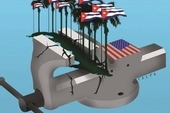
On June 12, Cuban President Fidel Castro and Vice-President Raul Castro led more than one million people in marches past the Spanish and Italian embassies in Havana. They were protesting against the European Union’s decision on June 5 to join Washington’s campaign of diplomatic provocations against the island.
In a television interview broadcast the evening before the march, Fidel identified the right-wing governments of Spain and Italy as the chief instigators of the EU decision. He called Spanish PM Jose Maria Aznar “a little fuhrer with a moustache and Nazi-fascist ideology” and Italian billionaire PM Silvio Berlusconi, a “burlesconi” – a Spanish pun suggesting a clownish fool.
In a statement released to the media on June 5 – hours before it was delivered to the Cuban government – the 15 member-countries of the EU announced that they would reduce “high-level” governmental contacts with Cuba and “invite Cuban dissidents to national holiday celebrations” at the Havana embassies of EU member states.
In response, the Cuban foreign ministry issued a statement on June 11 that said the EU’s decision was motivated by European leaders’ desire to show “their contrition and repentance over the differences that arose over the war in Iraq” between the EU and Washington.
The EU statement criticised Cuba's April execution of three members of a criminal gang that had hijacked a ferry.
The foreign ministry responded: “Cuba has never heard a word from the European Union condemning the death penalty in the United States. It has never seen the European Union spearhead a motion in the [UN] Human Rights Commission condemning the United States for inflicting the death penalty on minors, the mentally ill and foreigners who were denied their right to meet with their consuls.
“Cuba has never heard the European Union criticise the 71 executions that took place in the United States last year, including the executions of two women…
“Therefore, Cuba does not take the union’s lament seriously; it knows it is replete with hypocrisy and double standards.”
The EU also said it was “deeply concerned about the continuing flagrant violation of human rights and of fundamental freedoms of members of the Cuban opposition and of independent journalists” – a reference to the jail terms, averaging 19 years, given to some 70 opponents of the Cuban Revolution found guilty in early April of working for the US government.
In response, the Cuban foreign ministry criticised the EU's attempt to “disguise as `opposition members’ and ‘dissidents’ mercenaries in the pay of the US government, who hope to play their part from inside Cuba in the US government’s goal of overthrowing the Cuban Revolution”.
The statement added that Cuba has “never heard the European Union say one word of censure about the hundreds of prisoners – some of whom are Europeans – whom the United States is holding, in violation of the most basic norms related to human rights, in the naval base in Guantanamo which it has forced on us against our will.”
The statement continued: “The European Union has never said a word about the thousands of prisoners [who] the United States has kept locked up since September 11, often simply because of the way they look or because they are Muslims. These people do not enjoy even the most basic legal safeguards, nor have they been tried, and their names have not even been made public.”
It warned that the EU states would “be failing to meet their obligations under the Vienna Convention on Diplomatic Relations if they allow themselves to be used for subversion against Cuba” and would take the necessary measures to stop any such activity.
The statement also declared that “Cuba knows that the Spanish government has been funding the annexationist and mercenary groups that the [US] superpower is trying to organise in our country”.
Two days after the protest, the Cuban government took control of the Spanish embassy's cultural centre. “Far from promoting Spanish culture in our country – the reason it was created – it has maintained a program of activities unrelated to its original function, in open challenge of Cuban laws and institutions”, the Cuban foreign ministry said.
Washington is clearly having success in getting support from its partners in Europe for its anti-Cuba campaign. However, US Secretary of State Colin Powell’s appeal to Latin American leaders at the June 9-10 meeting of the Organisation of American States (OAS) – to join the US in seeking the overthrow of Cuba’s Communist-led government – fell largely on deaf ears.
In his address to the OAS summit – held in Santiago, Chile – Powell stated that “the people of Cuba increasingly look to the OAS for help in defending their fundamental freedoms”. During the next day’s closing statements, even as regional leaders vowed to fight poverty, corruption, and respect for human rights, Cuba didn’t even come up.
In a further rebuff to Washington, the OAS voted for the first time in its history against seating the US nominee – Rafael Martinez, a Cuban-American Republican Party official from Florida – for the body’s human rights commission.
Seeking to analyse Powell’s failure to elicit public endorsement for Washington's anti-Cuba campaign, the Christian Science Monitor quoted Larry Birns, director of the liberal Council on Hemispheric Affairs lobby group in Washington:
“An emerging entente among Brazil, Argentina, and Venezuela is raising the fundamental questions about whether neoliberal economic policy is even right for the region. In many ways, Castro has been asking those same questions. Many respect him for that.”
A more plausible explanation is that Latin American leaders know it would do nothing for their domestic popularity to line up with Washington in publicly attacking Cuba. The major improvements to quality of life that the Cuban Revolution has brought to working people are widely known and respected among Latin America’s impoverished voters.
Nestor Kirchner, Argentina’s newly elected, populist president came to office in what many see as a backlash against the previous government and its close economic ties with the US.
The Cuba issue strained US-Argentine relations last year when Argentina abstained from siding with the US in condemning Cuba over [alleged] human rights violations. Kirchner has been reluctant to criticize Castro as the Cuban president remains a popular revolutionary figure in Argentina.
At Kirchner’s inauguration two weeks ago in May, Fidel was heralded as a hero during an impromptu address to thousands on the streets of Buenos Aires.
TOP
Bookmark and Share RSS