Cuban student tours UK

05 February 2003

Cuba Si
The magazine of CSC
By Simon Watson
Spring 2012
Sport at the heart of revolution
Summer 2011
A socialist path to sustainability
A manufactured dissident
Breaking the Silence: Beyond the Frame- Contemporary Cuban Art
Restructuring the Revolution
Spring 2011
In Santiago it is always the 26th
50 years of solidarity
Revealing Che’s revolutionary roots
The Doctors’ Revolution
Winter 2011
Habana Hoy: The New Sound of Cuban Music
Gerardo remains positive
Playa Girón
Latin lessons: What can we learn from the world’s most ambitious literacy campaign?
Autumn 2010
Sustaining the revolution
Cuba and the number of “political prisoners”
Daughter of Cuba
La revolucion energetica: Cuba's energy revolution
Summer 2010
Noam Chomsky on Cuba-US relations - exclusive
Friends of Cuba Solidarity Campaign
Waste not, want not
Miami 5 updates
Spring 2010
Cubans in Haiti
Remedios y sus Parrandas
Concert for Haiti
The real war on terror
Auntumn 2009
Interview with families of the Five
Autumn 2009
Juan Almeida Bosque – hero of the revolution
Presidio Modelo, School of Revolutionaries
Summer 2009
From here to there - Interview with Omar Puente
Talking to Aleida Guevara
Pride in Cuba
Ken Gill ‘son of Cuba’
Cuba50 - 40,000 people join the celebrations
Spring 2009
Confronting rhetoric with reality
Talking about a Revolution
Pushing for a change in UK policy
A chance encounter with Operación Milagro
Winter 2008-9
Hasta La Victoria Siempre - Interview with Cuban poet who witnessed Revolution
The revolution that defies the laws of gravity
Feminising the Revolution
Autumn 2008
Families torn apart - Miami 5 interview
After the storm - Hurricane report
TUC Congress reports
Terror in Miami - Cuba's exile community
Summer 2008
Havana rights
AGM Report - CSC celebrates year’s successes
Miami Five – Ten years on
Changes in Cuba?
Spring 2008
Celebrating 50 years of progress
Fidel stands down
Libraries at the heart of the community
Lessons for a greener world
Cuba50 – Celebrating Cuban Culture
Winter 2007/08
“In every barrio, Revolution!” - CDR Museum opens
Fighting for the Five - Leonard Weinglass interview
The World of Work in a Changing Cuba
Campaign on Barclays and extraterritoriality continues…
Autumn 2007
21st century medicine
The living legacy of Che
Interviewing Fidel
Summer 2007
Farewell to Vilma:
From Pakistan to Rotherham:
Whose rules rule?
Spring 2007
Feeding the revolution
Stop the Hilton Hotels ban
Teaching citizenship the Cuban way
Winter 06/07
Exclusive: London's Mayor visits Cuba (inglés y espanol)
Rendezvous with lies
World Circuit Records celebrates 20 years
Autumn 2006
Life without Fidel
The landing of the Granma
America's favourite immigrants
Summer 2006
From Cuba with love: Cuban doctors in Pakistan
Teatro Miramar: a dream to be realised
Bush’s ‘secret’ plan for Cuba
Spring 2006
Exporting healthcare: Cuba and the real meaning of internationalism
Let there be Light
“Hombres not Nombres”
Winter 2005-6
Confessions of an “independent” trade unionist
We are stronger than ever
Europe partakes in a recipe for disaster cooked up in Washington
Autumn 2005
Brendan Barber pledges TUC support for Cuba
Five reasons why the people rule
Education from womb to tomb
Summer 2005
Bill and Joe’s Cuban cycle adventure
Poet of Guantanamo
Participation is key to Cuba’s democracy
Spring 2005
Is Venezuela next after Iraq?
Trip of a lifetime
Justice delayed, justice denied
Winter 2004/5
Cuba's Response to AIDS
Books: Bulwark against neo-liberalism
Guide to the `Report from the Commission for Assistance to a Free Cuba´
Autumn 2004
Book review: Cuba’s story
Autumn 2004
Heart strings
Speaking truth to power: Cuba at the UN
Summer 2004
Salud International to back Cuban internationalist doctors
Cuba saved my daughter
A revolution in culture
Spring 2004
Miami Five: Hopeful of justice
Biotech for all
US occupation of Guantanamo Bay is illegal, says top lawyer
Winter 2003/4
The truth about Reporters Sans Frontières
Solar-powered education
Charting women’s progress since 1959
Autumn 2003
Does the FCO website betray a political bias against Cuba?
Join the CSC bike ride to Cuba
How the US stole Guantanamo Bay
Summer 2003
Hands Off Cuba Campaign Launched
Monument to freedom
EU lines up with US
UK lawyer visits Havana
Ibrahim Ferrer: a lesson in greatness
My secret mission to meet Fidel
The Miami Five -an injustice too far
Spring 2003
Beyond the beach and sun:
CSC’s Father Geoff Bottoms visits one of the Five
Cuban student tours UK
Autumn 2002
British credit cards hit by US sanctions
Housing for the People
Moncada Day Cycle Challenge
Summer 2002
Evil Spirit
From May Day In Havana To The Cradle Of The Revolution
A dream for all times
How foreigners fuel US anti-Cuba policy
Spring 2002
African Roots
How the US planned to start a war with Cuba
Toys for Cuba
Welsh Education Minister meets Fidel
Cuban student tours UKCuban student tours UK
By Simon Watson

Shortly before 20,000 students demonstrated for ‘Grants not Fees’ in London last year, Ettianet Diaz Estrabao, teaching student and Secretary for Culture in the Cuban Union of Students (the FEU) toured the UK as a guest of CSC.
She talked about free education in third world Cuba, and the ‘Battle of Ideas’ to raise Cubans cultural, educational and social level.
Indeed, the difference in attitudes towards education between wealthy Britain and third-world Cuba was stark. Education is free in Cuba, at all levels. Students get grants, a universally accepted high quality education with falling class sizes and a job at the end of it. There is optimism and confidence in the future. It became almost embarrassing talking about this in a situation where most British students have to work to support themselves, live in very low quality accommodation, and leave college thousands of pounds in debt to often face low paid jobs and uncertainty.
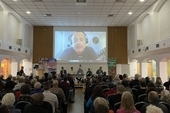
Ettianet spoke to over 500 people in 35 meetings with individuals and groups, including Chris Weavers, Vice-President for Education of NUS. Local radio and local and national newspapers covered her tour, which included over a dozen universities; school visits; meeting with trade unionists; many local CSC groups and even a reception with Mayor of Derby. The main topic was the Battle of Ideas.
The Battle of Ideas covers 70 programmes being undertaken throughout all aspect of Cuban life. The aim is to make Cuban society increasingly more just, equal and human in every area and dimension, and show that equality is not limited to opportunities, but also extends to possibilities. Some of it further strengthens areas like education, but many programmes address issues which confront Cuba as its own society changes, and rely on mobilising young people.
The side-effects on society of tourism are varied, but one of them is that it has been hard to attract young people into teaching in Havana. Class sizes were starting to rise, going against the priority of raising the quality of education. An emergency programme of primary school teacher training was introduced in five institutions. More than 5,500 young people between the ages of 16 and 17 enrolled for the ten month training course, after which they work in a primary school in their own community while simultaneously continuing their higher studies in one of 22 university programmes in the humanities. As of September 2000, no Cuban school had classes with more than 20 students, and many had 15 or less (some rural schools have one!).
In a similar way, intensive training courses for social workers have been introduced, to work with children, adolescents and the elderly and incorporate schools, teachers and the entire community in their work. 7,200 young people between the ages of 17 and 22 have been enrolled in intensive 10 month university courses, which then continue as distance education and in-service courses once they qualify. Over 1000 social workers have graduated from 4 schools across Cuba, and eventually there will be 35,000 – or one for every 300 inhabitants.
In May 2002, a third TV channel was launched, which is completely for educational purposes. It runs from 6.30am until late evening, and in the morning there are entertainment and educational programmes for primary school children (My TV to Grow). Later on there are programmes for middle school (My TV to Learn) and secondary school students (My TV to Know). Evenings have things like the discovery channel and programmes aimed university students. In primary and high schools there are TVs and videos in every classroom. In 1944 rural schools there is no electricity, so solar panels have been installed. These also help counteract the effect of the US blockade on teaching materials.
There are many other programmes too, such as training thousands of art instructors for visual arts, music, dance and theatre. Others include training for those (very few) who do not stay at school to complete their 9th grade education, tackling the link between low education and low culture leading to marginality and criminal activity. The introduction of IT into all aspects of education is developing apace, and 15,000 primary school teachers were given intensive courses in IT , so they could teaching the computer labs installed in every primary school in the country.
A final example (though there are more) is that of the university for all, through which distance learning courses are taught by television, broadcast to the entire country to enable the entire population with the opportunity for educational and cultural upgrading.
One of the things which came across in the different meetings was the difference in understanding of Cuba between those who had visited Cuba on a brigade or in solidarity, and those who had gone as tourists with little understanding of the revolution. Although there was general sympathy to Cuba from all those who had gone there, it was clear that people who had primarily seen Cuba from the viewpoint of a certain group of people in the tourist industry came away without understanding the depth and effect of the revolution. It is clear that there is still a struggle going on inside Cuba to counteract some of the negative social effects of tourism, and raising the level of culture and education in the Battle of Ideas is an important part of that struggle.
Ettianet was overwhelmingly well received as an eloquent advocate of Cuba by audiences on her tour, and good links were made with some colleges, and new people were attracted to local groups meetings. Thanks to the people helped organise meetings, many who had not been actively involved before.
CSC will be increasing its presence at NUS Conference, and if any students can help with this in April in Blackpool, please get in contact.

TOP Photo Ettianet Diaz Estrabajo
Bookmark and Share RSS